The university grading system in Nigeria is a very important part of a student’s education journey. It is the way schools measure how well students are doing in their courses, showing what they have learned and how much effort they put into their studies. For anyone who is studying in a Nigerian university, or planning to study, understanding the grading system is very helpful. It not only helps students keep track of their progress but also guides their parents and guardians in supporting them better. This system affects not just exam results but also the kind of degree a student graduates with, which can impact future jobs, scholarships, or higher education opportunities.
For students, knowing how grades are calculated and what they mean can help reduce confusion and stress, making it easier to focus on learning. It also helps students plan their study time, aiming for higher grades or understanding when they need extra effort.
Because the grading system plays such a crucial role in academic success and career planning, it’s important to explain it clearly. This article will break down how the Nigerian university grading system works, from the letter grades to the score ranges and how the Grade Point Average (GPA) and Cumulative Grade Point Average (CGPA) are calculated. We will also look at how degrees are classified at graduation and what all these grades mean for students’ futures. Whether you are a new student, a parent, or someone curious about studying in Nigeria, this guide will help you understand everything in simple and easy-to-follow language.
What is a Grading System?
A grading system is really just a way for schools and universities to check how well students are doing in their studies. Think of it as a report card that tells you how much you have learned and how well you understand the subjects you are studying. Instead of just guessing if a student is doing good or bad, the grading system gives a clear, fair way to measure performance.
When teachers give grades, they are showing whether a student is doing excellent work, doing okay, or having some difficulties that need attention. For example, if a student understands most of the lessons and scores high in tests, the grading system will reflect that with a good grade. But if a student misses many points or doesn’t understand the lessons well, the grade will be lower.
The grading system is important because it helps students see how they are doing academically. This way, students know if they need to study harder, ask for help, or keep up the good work. It also encourages them to improve and do their best. Without grades, it would be hard to know if a student is learning enough or if they need extra support.
In simple words, the grading system is like a guide or a feedback tool for students, teachers, and parents. It makes it clear where a student stands in their learning journey and helps everyone work towards better education outcomes.
Read Next: How to Calculate CGPA in Nigerian Universities | Full Guide
Types of Grading Systems in Nigerian Universities
In Nigerian universities, most schools use almost the same way to grade students, which makes it easier for everyone to understand how performance is measured. The common method you will find is the use of letter grades like A, B, C, D, and F. These letters represent different levels of achievement, with A being the best and F meaning a fail.
That said, not all universities use exactly the same system. Some universities prefer to show students’ marks as percentages first. Then, they convert these percentages into letter grades like A or B. Other schools might just give the letter grades without showing the exact percentage.
So, while the idea of grading is the same everywhere, to show how well students did, there are small differences in how some schools calculate or display these grades. But overall, the basic system of using letters tied to certain score ranges is very similar, making it easy for students, parents, and employers across Nigeria to understand the results.
This similarity helps a lot because if you move from one university to another, or apply for jobs or further studies, your grades can be understood without confusion. It also helps create fairness, so students are judged on similar scales no matter which Nigerian university they attend.
The Common Grading Scale Used
The typical Nigerian university grading scale includes letters and corresponding class levels:
– A (First Class) – This is the highest grade representing excellent performance.
– B (Second Class Upper) – A very good grade showing strong understanding.
– C (Second Class Lower) – A good pass grade.
– D (Third Class) – A modest pass but below average.
– F (Fail) – Indicates the student did not meet the minimum standard.
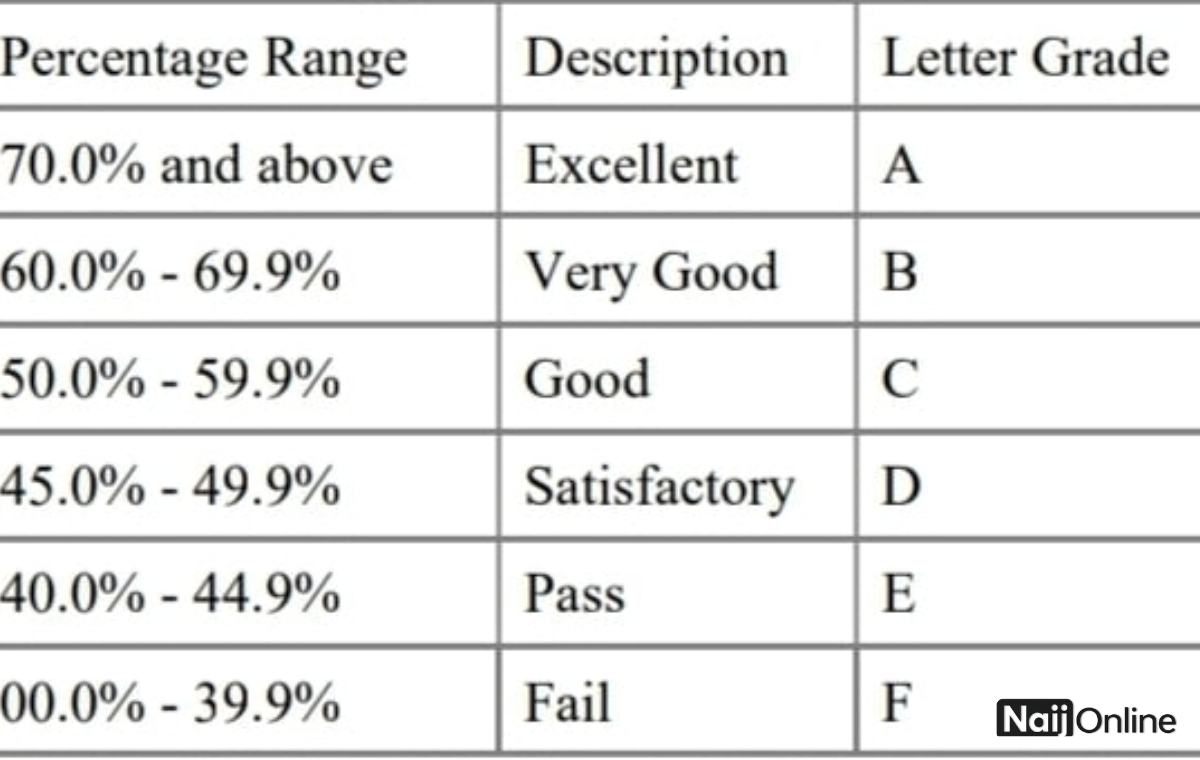
Each letter grade is linked to a percentage range of marks. For example, a score between 70% and 100% usually results in an A. The breakdown is generally as follows:
– 70% – 100% = A (First Class)
– 60% – 69% = B (Second Class Upper)
– 50% – 59% = C (Second Class Lower)
– 45% – 49% = D (Third Class)
– Below 45% = F (Fail)
This scale can vary slightly but is a common guideline.
Grade Point Average (GPA) and Cumulative Grade Point Average (CGPA)
GPA stands for Grade Point Average. It is a number that shows a student’s average performance in one semester. CGPA means Cumulative Grade Point Average. This is the average of all GPAs from every semester a student has completed.
To calculate GPA, each course’s grade is given points (for example, A = 5, B = 4, C = 3, etc.). These points are multiplied by the number of credit units for each course. Adding these results and dividing by the total credit units gives the GPA.
The CGPA is calculated the same way, but it includes all semesters’ courses since the student started university. CGPA is very important because it decides if a student can graduate and what degree classification they will receive.
Read Next: 15 Universities Offering Nursing in Nigeria | 2026 Update
How Marks Are Converted to Grades
Marks come from various assessments such as tests, assignments, project work, and final exams. Each of these carries a percentage weight. For example, tests might count for 30%, assignments 20%, and the final exam 50%. When all these are added, the student gets a total percentage mark for the course.
This total percentage is then matched against the grading scale to assign a letter grade. For example, if a student scores 72% overall in a course, that falls into the “A” grade bracket.
Example:
– Test score = 25 out of 30
– Assignment score = 18 out of 20
– Exam score = 40 out of 50
Total % = $$ \frac{25 + 18 + 40}{100} \times 100 = 83\%$$
This would be graded as an A.
Degree Classifications Based on CGPA
The final CGPA shows the overall academic standing of the student. Universities use this number to classify degrees as follows:
– First Class: CGPA between 4.5 and 5.0. This is the highest honor.
– Second Class Upper: CGPA between 3.5 and 4.49. A very good result.
– Second Class Lower: CGPA between 2.40 and 3.49.
– Third Class: CGPA between 1.5 and 2.39.
– Pass: CGPA between 1.0 and 1.49.
– Fail: CGPA below 1.0, which means no graduation.
These classifications affect how employers or graduate schools see a student’s abilities. For example, getting a First Class can open many doors as it shows outstanding achievement.
Special Notes on Grading
In some Nigerian universities, students receive both percentage scores and letter grades for clear understanding. Continuous assessment (CA) is very important; students are graded not only on final exams but on assignments, quizzes, and projects throughout the semester.
If a student fails a course, many universities allow retakes or supplementary exams to try again. However, this depends on university rules. Failing too many courses can delay graduation or lead to suspension.
Read Next: 10 Best Science Courses to Study in Nigeria | 2026 Update
Why Understanding the Grading System Is Important
Understanding the university grading system in Nigeria is very important for several reasons. For students, knowing how the system works helps them plan their studies better. When students know what scores they need to get certain grades, they can set clear goals for themselves. For example, if a student knows they need at least 70% to get an “A” or First Class grade, they can focus on studying harder in areas where they are weak to reach that target. This helps them stay motivated and organized throughout their university life.
For parents, understanding how the grading system works makes it easier to make sense of their children’s results. Sometimes when students get their grades, parents might not understand what those numbers or letters really mean. But when they know the system, they can better support their kids, encourage them to improve, or celebrate their successes.
The grading system also plays a big role when students finish university and look for jobs or want to continue their studies. Many employers and graduate schools check the degree classifications or CGPA to decide who to hire or accept. A higher CGPA or better degree class often means better opportunities. So, if students understand how their grades affect their future options, they can work harder to improve and increase their chances of success.
Therefore, knowing the grading system is like having a map for your educational journey, it shows you where you are, where you want to be, and how to get there. This knowledge makes it easier to plan, work smarter, and achieve better results in school and beyond.
Conclusion
The university grading system in Nigeria is a crucial part of the academic journey for any student. It measures performance through a combination of tests, assignments, and exams, using letter grades linked to percentage ranges. GPA and CGPA summarize how well a student is doing each semester and overall, determining the final degree class.
Understanding this system helps students set goals, work hard, and achieve good results. It also makes it easier for parents to interpret academic reports and for graduates to prepare for future opportunities. Ultimately, the grading system is a useful tool to track academic success and encourage continuous learning. Students are encouraged to study diligently and aim for the best grades they can achieve, knowing this will benefit them throughout their lives.